Healthcare AI Data Handling Under HIPAA: How Executives Reduce PHI Risk Without Slowing Workflow

As healthcare organizations accelerate AI adoption, HIPAA compliance has shifted from a legal checklist to an operational design challenge. Executives are no longer asking whether AI can be used with PHI, but how to architect data flows that reduce risk without slowing care delivery. In a HealthAI Collective lightning talk, Adam El Gerbi offers a pragmatic view of HIPAA and AI data handling, focusing on how leaders can design workflows, access controls, and system boundaries that protect PHI while still enabling scalable, real-world AI use.
Key Takeaways
- HIPAA compliance for AI is fundamentally an architecture and workflow design problem, not just a legal one.
- The primary driver of PHI risk is how data flows through systems, not the AI models themselves.
- Reducing data movement and surface area is the most effective way to lower HIPAA exposure.
- Strong access controls and system boundaries can accelerate AI adoption when designed correctly.
- Executive oversight of AI data handling must sit with operations and technology leaders, not only legal teams.
A Practical Approach to HIPAA and AI Data Handling in Healthcare
When AI is introduced into healthcare operations, HIPAA becomes a practical constraint on how everyday workflows are designed. Organizations that support physicians and handle patient information encounter compliance questions during routine tasks, not during formal reviews.
Handling patient demographics, eligibility checks, or data evaluation often requires moving sensitive information between systems. The risk does not come from intent, but from how these routine data exchanges are structured.
The key insight is not that organizations need exhaustive compliance programs. It is that leaders must understand where PHI is actually touched in daily operations and apply reasonable safeguards where risk is highest.
What Is at Stake When AI Touches PHI
When AI systems interact with PHI, the stakes go beyond regulatory penalties or reputational damage. A single avoidable exposure can trigger cascading consequences across legal risk, partner trust, customer retention, and an organization’s ability to deploy AI at all.
Enforcement risk is real, and penalties can accumulate, particularly when organizations fail to conduct basic risk analysis or remediate known gaps. Many failures are not advanced or novel. They stem from foundational issues such as misconfigured portals, exposed electronic PHI, or missing controls.
A recurring problem is lack of visibility. Organizations cannot manage risk they cannot see, especially when data moves across systems and responsibilities are unclear.
This applies equally to business associates. If an organization supports providers, payers, or healthcare operations in any capacity, HIPAA liability follows the data. It cannot be treated as someone else’s problem.
Where HIPAA Risk Shows Up in Real Workflows
A simple and effective way for executives to structure HIPAA risk discussions is to distinguish between data at rest and data in transit.
Data at rest
- Stored within systems such as databases, internal drives, or approved vendor platforms
- Typically protected by established security controls and access policies
Data in transit
- Moving through email, file transfers, web applications, APIs, or ad hoc exports
- More difficult to monitor and control consistently
The highest risk often appears when PHI leaves its system of record. Examples include data copied into spreadsheets, pasted into external tools, or shared through workflows not designed to handle sensitive health information.
Decision criteria for leaders
- Where does PHI get exported, even temporarily?
- Which tools handle PHI outside core clinical or operational systems?
- Can access be traced by user, time, and dataset?
- Are controls enforced technically, or documented only in policy language?
What “Reasonable Effort” Means for Healthcare Executives
Most of these safeguards are familiar to security leaders. Their executive value lies in how they function together as an operating baseline for AI deployment, not as isolated compliance tasks.
The following controls represent a reasonable and defensible standard when AI workflows interact with PHI:
Core safeguards
- Annual HIPAA risk analysis
- Ongoing security and HIPAA training
- Defined remediation planning for breaches
- Two factor authentication
- Least privilege access
- Audit level access logging
- Vendor selection that supports business associate agreements
- Data encryption for storage and transfer
- VPN usage for remote work
- Automatic device locking
These controls reduce downside risk while allowing teams to modernize workflows with confidence. They also create auditability, which becomes essential once AI systems begin touching sensitive operational data.
How Local LLMs Can Reduce PHI Exposure Before Using Hosted AI Tools
One of the most practical patterns discussed was a local-first approach to AI data handling. Instead of sending raw data directly to hosted AI tools, teams can process sensitive information locally first.
In this pattern, a local language model runs entirely within a controlled environment, such as a laptop, without sending data to the internet. A common use case is removing or masking PHI from datasets so that safer versions can be used for internal analysis, training data, or downstream workflows.
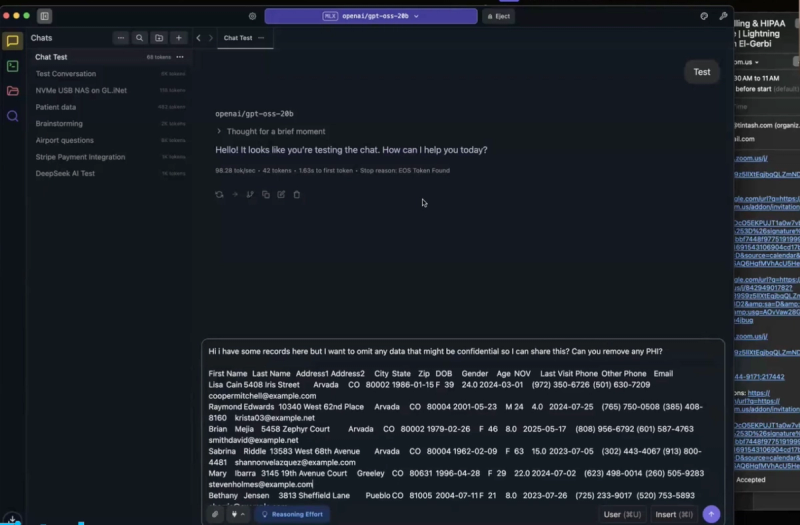
This is not an argument against hosted models. Hosted tools may still be better suited for complex tasks. The operational insight is that local tools can act as a preprocessing layer, reducing exposure before data ever leaves a controlled environment.
A pragmatic workflow pattern
- Use a local model to anonymize or remove sensitive fields
- Review outputs before any external sharing or tool ingestion
- Use hosted models only after data has been appropriately sanitized
This pattern is governance friendly because it establishes a clear boundary. PHI remains inside controlled environments unless and until it has been intentionally transformed.
How to Keep Compliance From Turning Into Operational Drag
In healthcare organizations, compliance is often cited as the reason execution slows down. In practice, delays are frequently caused by unclear processes and coordination gaps rather than unavoidable HIPAA requirements.
A useful executive litmus test is turnaround time. A few working days for sensitive data requests can be reasonable in complex environments. When basic reports or access requests take weeks, the issue is usually operational friction, not regulatory constraint.
What leaders can do
- Separate true compliance requirements from accumulated process debt
- Require clear service level expectations for routine reporting and access requests
- Invest in logging and role based access so risk teams can approve requests faster
- Treat delays as workflow optimization opportunities, not compliance realities
When compliance functions as an enabler rather than a blocker, organizations move faster without increasing risk.
About the Speaker
Adam brings 15+ years of technology leadership across healthcare, real estate, entertainment, and other sectors to MedAlly. He architected solutions ranging from healthcare SaaS platforms and ML systems to multi million dollar infrastructure transformations for organizations of all sizes. After gaining insights into the concierge medicine industry, Adam recognized an opportunity to bring greater efficiency and value to this market. He founded MedAlly to help physicians with concierge medicine through strategic guidance, technical excellence, and partnership focused support.
Watch the Full Talk
AI Data Handling & HIPAA in Healthcare